
How to Choose the Right Convex Traffic Mirror for Maximum Safety?
Introduction
Drivers, pedestrians and facility managers all place safety on the top of their priority list. This includes parking lots, industrial sites, and roads. A convex mirror is one of the easiest and most effective ways to improve visibility and prevent accidents. These mirrors give drivers and operators a wide-angle perspective of blind spots, driveways and corners.
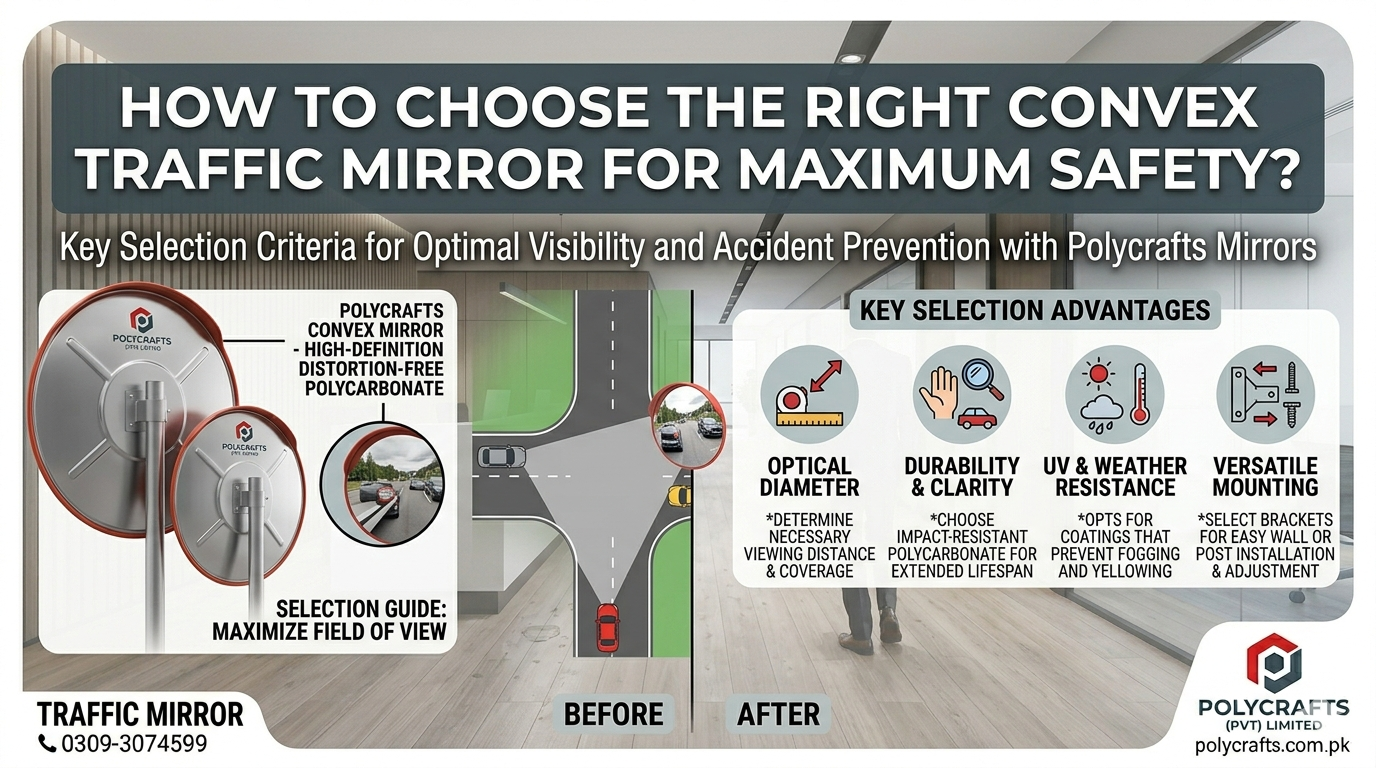
To maximize the effectiveness of your convex mirror, it is important to choose the right one. Performance can be affected by factors such as the size, mounting options and location. This comprehensive guide will explain how to choose the right convex mirror for your needs, as well as its advantages, tips on installation, and how to integrate it with other road safety equipment in order to create a safe environment.
What is a Convex Traffic Mirror
A convex mirror has a curved reflective surface that is designed to provide a larger field of vision than a flat traffic mirror. Curvature provides panoramic visibility and makes it easier to spot blind corners, driveways or intersections.
Convex Traffic Mirrors
- Wide Angle Visibility: Provides a wide perspective and reduces blind spots.
- Durability Made of materials such as polycarbonate or shatterproof glasses for outdoor use and high traffic.
- Weather Resistant: Many of the mirrors on the market are made to resist rain, UV exposure and extreme temperatures.
- Easy Installation: Can mount on poles, walls, or fences to maximize coverage.
Common Applications
- Blind curves and road intersections
- Parking lots and driveways
- Warehouses and factories for industrial use
- School zones and pedestrian zones
- Residential complexes
Convex Traffic Mirrors: What are the benefits?
Improved Road Safety
Convex traffic mirrors are designed to increase visibility and improve safety. The drivers can see approaching cars, cyclists or pedestrians and reduce the risk of an accident.
Reduce Blind Spots
Convex mirrors increase the visibility area and allow drivers to make better decisions at blind intersections or corners. This is particularly useful in narrow industrial spaces or alleys.
Cost-Effective Safety Solutions
Convex mirrors offer a cost-effective solution for improving safety compared to building new roads, installing traffic signals or adding additional infrastructure.
Integration with Other Road Safety Equipment
Convex traffic reflectors can be used in conjunction with other road safety equipment, such as bollards and warning signs, to create a comprehensive safety system for roads, parking lots, and industrial sites.
Factors To Consider When Selecting a Convex Traffic Mirror
Selecting the correct mirror will ensure maximum safety and durability. Take into consideration the following factors.
Mirror Material
- Acrylic mirrors: Lightweight and shatter-resistant. Suitable for areas with moderate traffic.
- Mirrors made of polycarbonate: Highly durable and resistant to harsh weather, impact and impacts.
- Shatterproof glass mirrors: Ideal for areas with high traffic where visibility and reflectivity are important.
Size and shape of the mirror
- Size Larger mirrors offer a larger field of vision but require stronger mountings.
- Shape Circular or rectangular mirrors can be used for intersections and streets, but they are more common in industrial or warehouse corridors.
Mounting Options
- Wall Mounted: Ideal to be mounted on corners and driveways.
- Pole Mounted: Commonly used on roads and parking areas for flexible positioning.
- Fence or barrier mounting: Used in industrial settings to monitor the movement of equipment.
Environmental Considerations
- Weather Resistant Mirrors: Make sure that mirrors are UV protected and resistant to wind, rain and snow.
- Temperature tolerance: Certain materials perform better at extreme temperatures.
- Resistance to Vandalism: Polycarbonate Mirrors are resistant to impact and scratches.
Installation Guide for Convex Traffic Mirrors
Installation is crucial to the effectiveness of your mirror.
Placement Tips
- Height: Install the mirrors at the eye level of approaching motorists for maximum visibility.
- Angle: Adjust your mirror to eliminate blind spots while maintaining a large viewing area.
- Distance: Set mirrors at the appropriate distance based on road width, traffic speed and other factors.
Maintenance Recommendations
- Keep the mirrors clean by cleaning them regularly.
- Check the mounts and tighten any bolts that need to be tightened.
- To maintain visibility, replace damaged or faded mirrors immediately.
Types of Convex Traffic Mirrors
Outdoor Convex Traffic Mirrors
- The product is designed to endure outdoor conditions.
- Many come with a UV coating to help prevent discoloration.
- Ideal for driveways, industrial yards, and streets.
Indoor and Industrial Mirrors
- Use in factories and warehouses
- Monitor forklifts and machinery as well as employee movements.
- Polycarbonate is used for its durability and impact resistance.
LED or Solar-Powered Mirrors
- Features integrated lighting for improved visibility at night.
- Ideal for intersections with poor lighting or high-speed roads.
Avoiding Common Mistakes
- Mirrors installed too high or low.
- Mirrors made of low-quality materials degrade rapidly.
- Neglecting reflective coatings when the sun is bright or there are glare problems.
- Fail to combine mirrors and other road-safety equipment, such as bollards or bumps.
FAQs about Convex traffic mirrors
Q1: Do convex traffic mirrors work in rainy or foggy conditions?
A1: Yes, especially those with anti-glare and water-resistant coatings. They enhance visibility in poor weather.
Q2: What size convex mirror should I choose for a road intersection?
A2: A mirror with a diameter of 600-900 mm is recommended for typical intersections, but this may vary depending on road width and traffic volume.
Q3: Can convex mirrors prevent accidents in industrial settings?
A3: Absolutely. Mirrors in warehouses and factories reduce blind spots for forklifts and machinery, preventing collisions.
Q4: How often should I maintain or clean the mirrors?
A4: Mirrors should be cleaned weekly in dusty or industrial environments and inspected monthly for damage.
Q5: Are LED or solar-powered convex mirrors necessary for all locations?
A5: No, they are particularly useful for low-light roads or areas without street lighting. Standard mirrors work fine for well-lit environments.
Q6: How do convex mirrors integrate with other road safety equipment?
A6: They complement road safety equipment like speed bumps, bollards, and traffic signs, creating a comprehensive safety system for roads and industrial sites.
Conclusion
It is important to choose the correct Convex Traffic Mirror, industrial areas, and on roads. You can maximize visibility and prevent accidents by considering the material, mounting options, size and environmental conditions.
Mirrors of high quality, when combined with other safety equipment enhance the operational efficiency and protect pedestrians and drivers in commercial and industrial environments. Convex mirrors that are durable and placed correctly can make traffic and work zones safer.

 English
 Arabic
 French
 Spanish
 Portuguese
 Deutsch
 Turkish
 Dutch
Dutch
 Italiano
 Russian
 Portuguese (Brazil)
 Greek
Greek