
How Convex Mirrors Prevent Accidents in Busy Areas
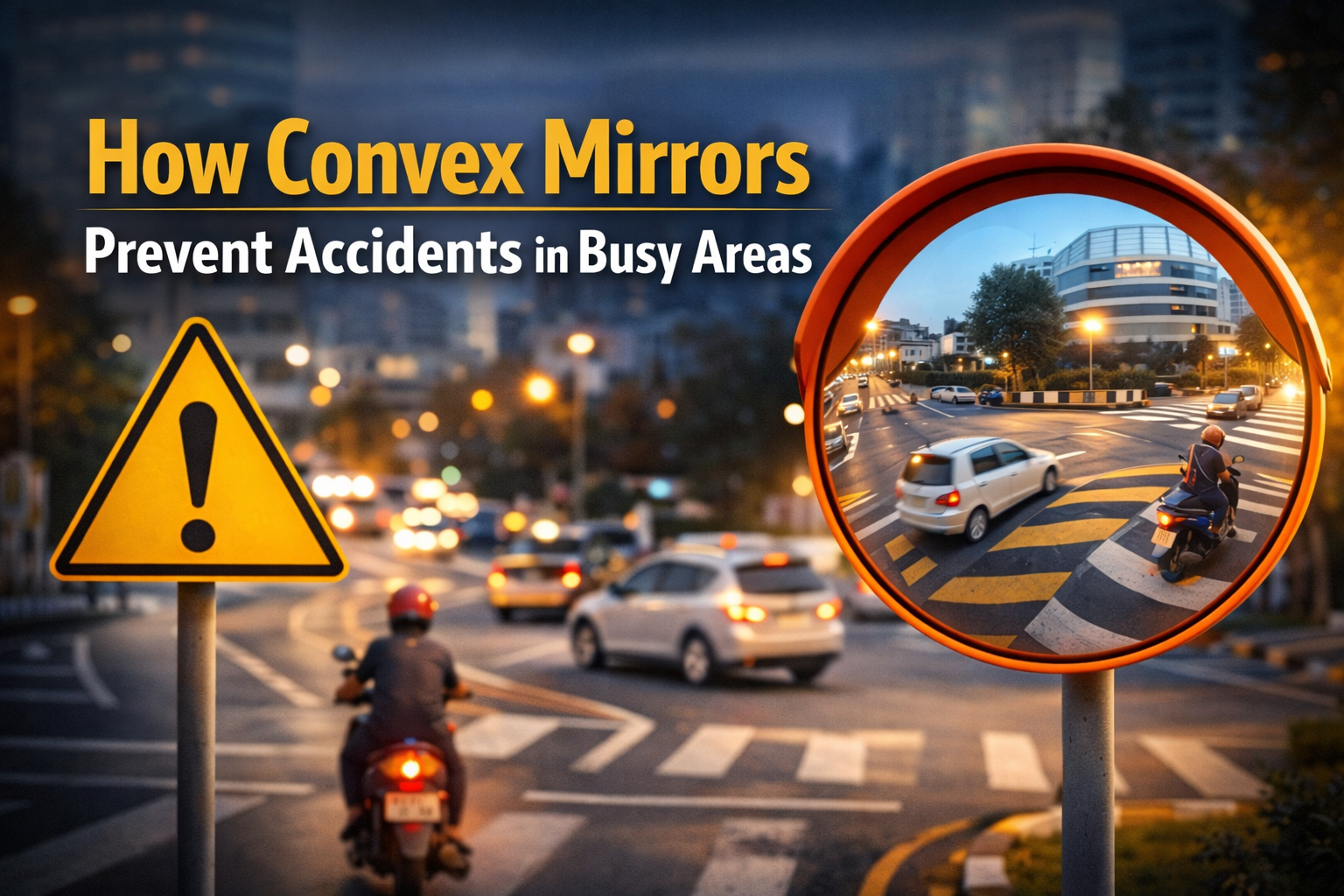
Accidents in high traffic areas are an issue which we see very often in urban streets, at intersections, in parking lots and within industrial zones. We see that dense traffic, blind spots, and poor visibility are great factors in causing accidents, property damage, and injuries to pedestrians. One of the best solutions we have for this is the use of convex mirrors. When put in strategic locations these mirrors improve visibility which in turn helps drivers and pedestrians make better, safer decisions. This guide looks at the role of convex mirrors in accident prevention, what types there are, best methods of placement and how they do best when used in conjunction with other safety measures like expansion joints to create better, safer settings.
What Is a Convex Mirror?
A convex mirror which is a curved mirror that projects outwards, also which has a wider field of view than a flat mirror. This wide angle reflection is especially useful in low visibility areas like sharp turns, parking garages and busy intersections. Convex mirrors reduce blind spots and allow drivers to see approaching cars, pedestrians, and obstacles thus which in turn makes for better driving decisions.
Key Features of Convex Mirrors
- Wide Field of View: Includes a larger area.
- Enhanced Safety: Reduces blind spots, thus in turn reduces collisions.
- Durable Materials: Usually what you will see is that they are made of acrylic, polycarbonate, or high grade stainless steel.
- Weather Resistant: For indoor and outdoor use.
Importance of Convex Mirrors in Busy Areas
In busy areas which include city intersections, shopping malls, industrial facilities, and parking lots safety is compromised by congestion and limited visibility. Convex mirrors play a large role in this safety issue.
- Improved Visibility: Drivers can see what is approaching from out of sight.
- Reduced Accidents: Helps out by alerting drivers to issues and warning of oncoming traffic.
- Pedestrian Safety: Pedestrians have an unobstructed view of oncoming traffic, especially in complex intersections.
- Traffic Flow Management: Improves traffic flow by which in turn allows for safer lane changes and turns.
Types of Convex Mirrors
Convatt all sorts of convex mirrors which are designed for different settings and safety requirements:.
- Wall-Mounted Convex Mirrors: Installed in building corners, warehouses, or in corridors for better visibility.
- Pole-Mounted Convex Mirrors: At outdoor intersections and in parking areas.
- Shatterproof or Acrylic Convex Mirrors: Durable mirrors for high traffic areas and industrial zones.
- Vehicle Convex Mirrors: Equipped in trucks and buses which is for the purpose of reducing blind spots.
In each case the purpose is different in regard to location, traffic volume, and environmental conditions.
Installation of Convex Mirrors
Proper fitment is the base for getting the most out of convex mirrors. Which includes:.
- Identify Critical Zones: Look to blind corners, high traffic intersections, parking areas, and narrow industrial pathways.
- Height & Angle Adjustment: Place the mirrors at a height and angle which provides the greatest field of view with no distortion.
- Secure Mounting: Use solid brackets and poles to ensure the mirror’s stability in weather or drop.
- Maintenance: Maintain mirrors’ cleanliness which in turn prevents accumulation of dirt, dust or rain which blur visibility.
Convex Mirrors and Expansion Joints: A Safety Lockout
While convex mirrors improve visibility, safety infrastructure in the form of expansion joints goes into the structural integrity of roads, bridges, and parking areas. Expansion joints absorb vibrations, thermal expansion, and minor structural issues which in turn prevent cracks and hazards that may cause accidents. Together convex mirrors and expansion joints present a better safety environment by:.
- Minimizing collision risks through better visibility.
- Reducing structural issues such as that of the road and floor.
- Improving traffic flow in heavy traffic.
Benefits of Convex Mirrors
- Accident Prevention: In clear weather accidents are reduced in dense traffic.
- Wide Coverage: One mirror to cover many lanes or intersections.
- Cost-Effective: Durable mirrors reduce the need for frequent changes.
- Versatile: Can use in indoor or outdoor settings, in warehouses, on vehicles.
- Enhanced Safety for Pedestrians and Drivers: Provides an insight into risk.
Best Practices for Convex Mirror Implementation
In these busy areas to get the best from your convex mirrors do this:.
- Strategic Placement: Identify areas of high risk which see low visibility.
- Height Optimization: Install at proper height for best field of view.
- Regular Maintenance: Make sure mirrors are clean, reflective, and in good repair.
- Complementary Safety Measures: Along with expansion joints, speed humps, traffic signs, and lane markings.
- Quality Materials: Use resistant to the elements and unbreakable mirrors which stand up to the environment.
Case Study: Curved Reflective Surfaces in Towns and Cities
In urban areas across the world convex mirrors have been a key element in traffic incident reduction. In multi level parking garages we see that installing mirrors at blind spots had a 30% drop in vehicle collisions. Also at intersections we note that with the use of mirrors we had better results in terms of lower number of pedestrian accidents as drivers are able to see cross traffic sooner. Also we see those which do a good job in conjunction with expansion joints to keep roads and floors safe in high traffic situations.
Selecting the Proper Convex Mirror for Your Requirements
When you choose a convex mirror consider this:.
- Location: In terms of indoor and outdoor, parking lots and roads.
- Mirror Size: Bigger mirrors cover greater areas but at a higher cost.
- Durability: In high traffic areas acrylic and polycarbonate mirrors do best.
- Mounting Options: Wall mounted, pole mounted, or vehicle mounted by location.
- Complementary Safety Measures: Make sure to match up with expansion joints, lane markings, and guard rails.
FAQs About Convex Mirrors
In what way does a convex mirror improve safety?
A convex mirror gives a broad field of view which in turn allows drivers and pedestrians to see out of sight hazards thus reducing accidents.
Where do we put convex mirrors in large traffic areas?
They may be seen at blind corners, intersections, in parking garages, at driveways, and in industrial zones.
Which materials are used for making durable convex mirrors?
Acrylic, polycarbonate, and stainless steel are what is used for shatterproof, weather resistant mirrors.
What is the role of expansion joints in relation to convex mirrors?
Expansion joints which prevent issues like cracking or potholes, thus we are able to report which roads and floors are safe for use by cars and pedestrians.
May convex mirrors be used on vehicles?
Yes I see that convex mirrors are used in trucks, buses and delivery vehicles.
Do convex mirrors require much care?
Minimal care is required for mirrors to stay reflective and effective, just clean and do a check up occasionally.
Are there solar powered convex mirrors?
Rarely do we see lighting is installed in very large convex mirrors for night time visibility in high risk areas.
Conclusion
Safety in many areas is a complex issue. Convex mirrors are key which we see in how they improve the visibility for drivers and pedestrians, which in turn reduces blind spots and decreases accidents. We also see that when they are used in association with structural safety features like expansion joints they play a role in the creation of a very strong system which in turn makes roads, parking lots, and industrial spaces safe for all. Putting in high quality convex mirrors and related infrastructure isn’t just a protective measure, it is a proactive move toward better, more intelligent urban and industrial planning.

 English
 Arabic
 French
 Spanish
 Portuguese
 Deutsch
 Turkish
 Dutch
Dutch
 Italiano
 Russian
 Portuguese (Brazil)
 Greek
Greek